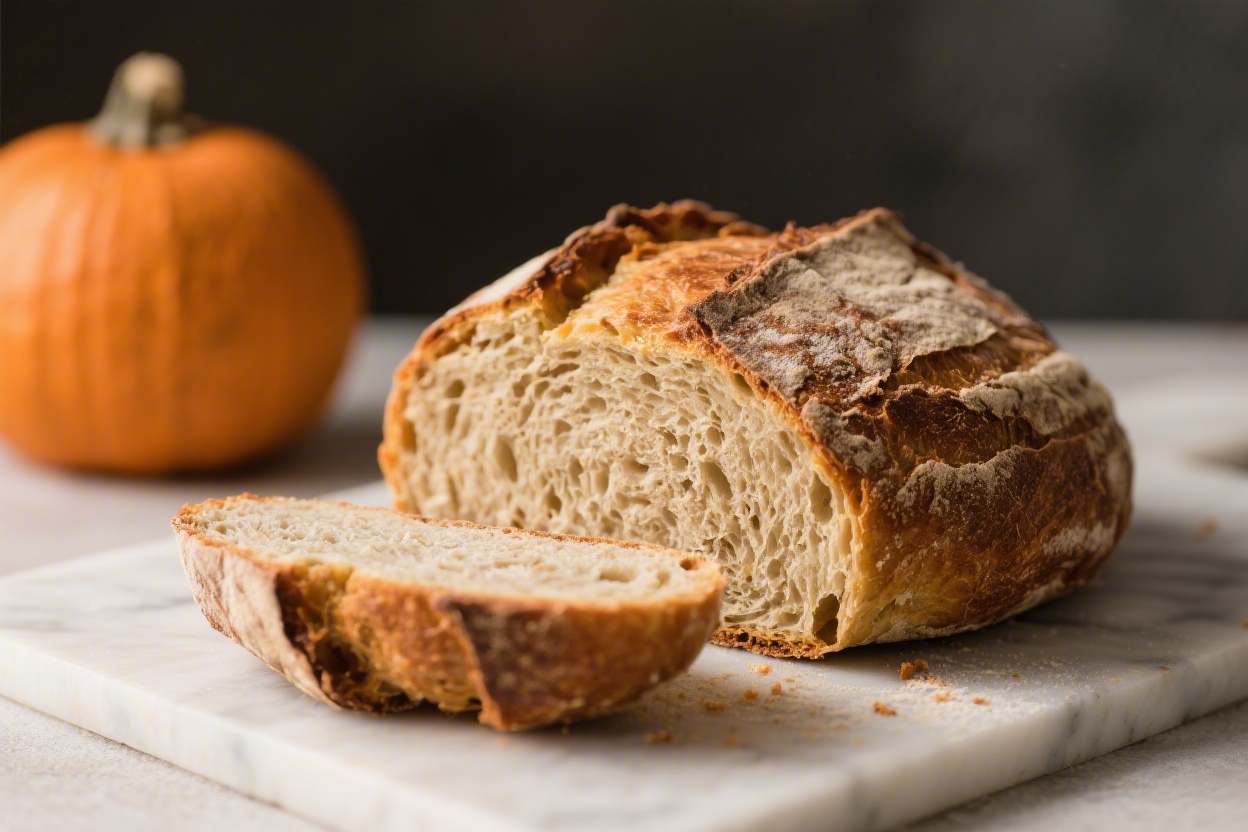
Make sure your starter is ready. Feed it 4–8 hours before mixing, depending on your routine. It should be puffy, doubled, and pass the float test when a small spoonful is dropped into water.
Mix the wet ingredients. In a large bowl, whisk together the pumpkin purée, water, honey or maple syrup, and oil or butter if using.
Stir in the active starter until it’s mostly dissolved.
Add the dry ingredients. Sprinkle in the bread flour, whole wheat flour, salt, and spices. Mix with a dough whisk or your hand until no dry bits remain. The dough will be sticky but should hold together.
Rest for 30 minutes (autolyse). Cover the bowl and let the dough rest.
This helps hydrate the flour and makes the dough easier to handle.
Begin gluten development. Over the next 2 hours, do 3–4 rounds of stretch-and-folds, spaced 30 minutes apart. With damp hands, grab a portion of the dough, stretch it up, and fold it over itself. Turn the bowl and repeat 4–6 times per round.
The dough should become smoother and bouncier.
Bulk ferment. Cover the bowl and let it rise at room temperature until it increases by about 50% and shows bubbles along the edges. Depending on room temperature, this takes 3–6 hours. Aim for dough that’s airy but not collapsing.
Pre-shape. Lightly flour your work surface.
Turn out the dough and gently shape into a loose round. Let it rest, seam-side down, for 15–20 minutes to relax the gluten.
Final shape. Shape into a tight boule or batard. Use a bench scraper to build surface tension without tearing the dough.
Dust a proofing basket (banneton) generously with rice flour and place the dough seam-side up in the basket.
Proof. Cover and refrigerate for 8–16 hours for a slow, cold proof. The dough should look slightly puffy and hold its shape when pressed gently.
Preheat the oven and Dutch oven. Place a lidded Dutch oven inside and preheat to 450°F (232°C) for at least 30 minutes.
Score and bake. Turn the dough onto a piece of parchment, seam-side down. Score with a sharp lame or knife.
Transfer carefully to the hot Dutch oven, cover, and bake for 22–25 minutes. Remove the lid and bake another 18–22 minutes, until deep golden and the internal temperature reaches about 206–208°F (97–98°C).
Cool completely. Let the loaf cool on a rack for at least 1–2 hours before slicing. Sourdough finishes setting as it cools; cutting early can make the crumb gummy.